
All the Features of an Advanced Sound Meter – over I²C bus.
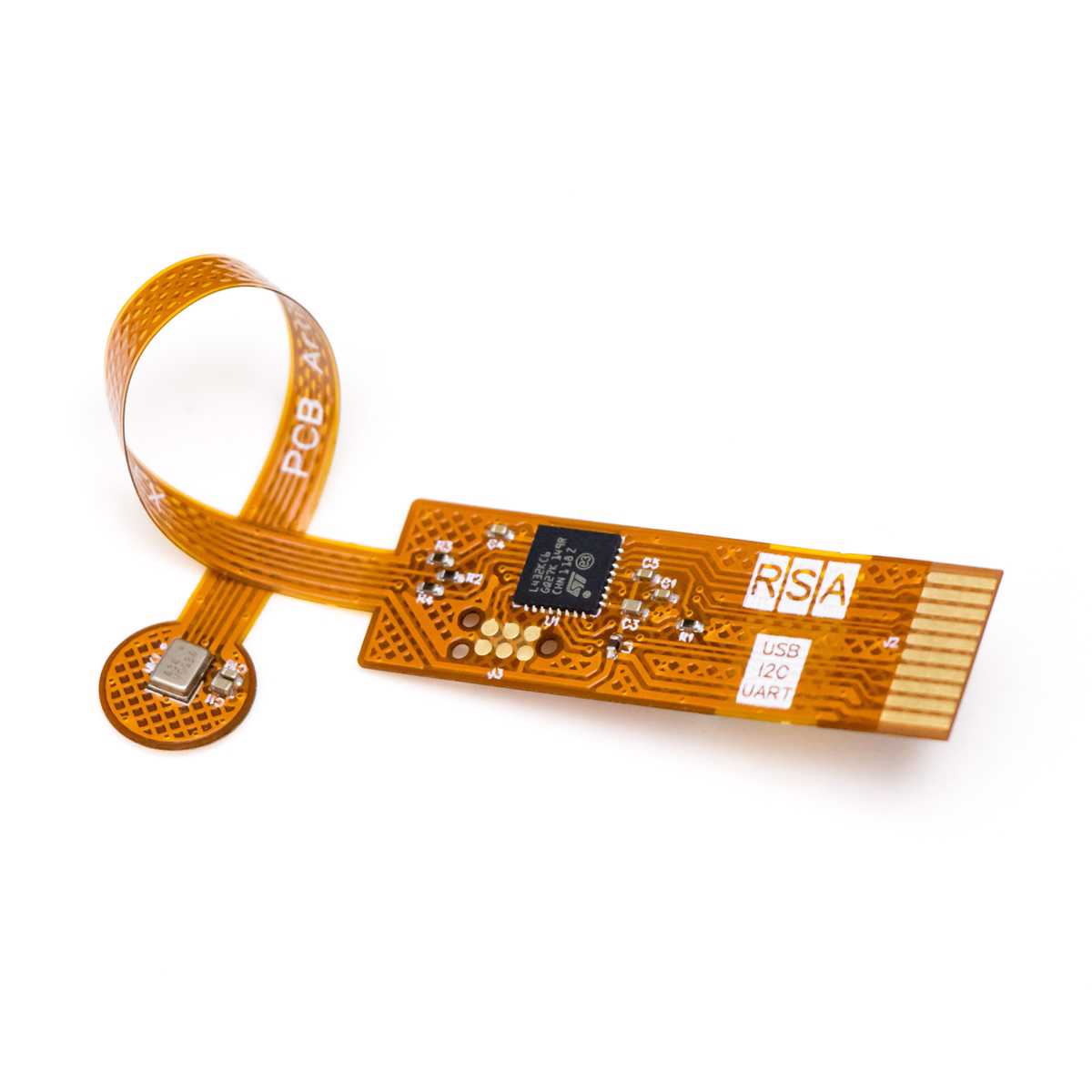
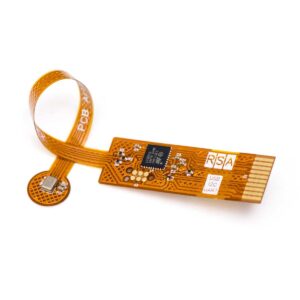
The unique PCB Artists PCBA-DBM-FLEX series of sensors bring ultra-low power sound level measurement to any embedded system. Simply plug in the module and read real-time, calibrated sound level parameters over I²C, including frequency- and time-weighted levels, Leq levels, peak sound level and 12-hour level history.
The new PCBA-DBM-FLEX-Oct now adds accurate third-octave and octave band analysis.
Legacy vs Octave Analyzer
Note: The backward-compatible Legacy module replaces the “Advanced Sound level Meter Module” from November 15, 2026.
Both variants share the same core sound level measurement engine and hardware. The only difference between them is the octave measurement capability, power consumption, and parameter refresh rate.
Our lowest power module with full sound level meter feature set. Suitable for battery-based loggers and always-on sound monitoring.
- Active
- 1.9 mA
- Sleep
- 8 µA
- Refresh Rate
- 40 Hz
- Bands
- —
- LA, LC, LZ with Fast, Slow or custom time weighting
- Leq, Peak, Min/Max tracking on A, C, and Z weightings
- 60 seconds / 60 minutes / 12 hours LAeq history
- Exposure-time counters and threshold interrupts
Choose Legacy if you need robust sound level measurement and power consumption matters.
Everything Legacy measures with faster refresh rate, plus a real-time octave and third-octave band analyzer built to IEC 61260-1 Class 2.
- Active
- 7.6 mA
- Sleep
- 10 µA
- Refresh
- 62.5 Hz
- Bands
- 9 + 27
- Everything in Legacy
- 9 octave bands, 31.5 Hz – 8 kHz
- 27 third-octave bands, 20 Hz – 8 kHz
- Band filters referenced to IEC 61260-1 Class 2*
- Interrupt on any single octave band
Choose Octave Analyzer if you need to know which frequencies are loud. Suitable for machine noise monitoring, HVAC or noise-control.
Important Specifications
Acoustic
| Accuracy | ±1 dB (1 kHz, 94 dB SPL) |
|---|---|
| Linear Operating Range | 30 – 130 dB SPL (A-weighted) |
| Noise Floor | 26 dBA · 34 dBC · 37 dBZ |
| Acoustic Overload Point (AOP) | 131 dB SPL |
| Reading Resolution | 0.01 dB |
| Flat Response | 20 Hz – 10 kHz (under 2 dB error) |
| Frequency Weighting | A, C and Z (simultaneous) |
| Time Weighting | Fast 125 ms, Slow 1 s, Custom 1 – 65,535 ms |
Electrical
| Supply Voltage | 1.70 – 3.6 V 3.6 V absolute max |
|---|---|
| Power-up Inrush | 80 mA for 0.2 ms (15 µF on board) |
| Interface | I²C, 100 / 400 kHz, Address (fixed): 0x48 |
| SDA, SCL, INT | Open-drain, 5 V tolerant (external pull-ups required) |
| Operating Temperature | −40 to 85 °C |
Legacy vs Octave Analyzer
| Legacy | Octave Analyzer | |
|---|---|---|
| Measurement | ||
| A, C, Z Weighting | Simultaneous | Simultaneous |
| Leq fast / slow, Peak, Min/Max | ✓ | ✓ |
| 60 s / 60 min / 12 h History | ✓ | ✓ |
| Octave bands | — | 9, 31.5 Hz – 8 kHz |
| Third-octave bands | — | 27, 20 Hz – 8 kHz |
| Reading refresh | 40 Hz (25 ms) | 62.5 Hz (16 ms) |
| Power | ||
| Active Current @ 3.3 V | 1.9 mA | 7.6 mA |
| Sleep Current @ 3.3 V | 8 µA | 10 µA |
| Data Valid (after power-up) | 100 ms (max) | 120 ms (max) |
| Interface | ||
| Interrupt Sources | 12 Parameters | 12 Parameters + 9 Octave Levels |
VERSION Register | 0xA0 | 0xAD |
| Pinout, Footprint | Identical — 10-pin 1 mm FPC | |
Datasheets and Resources
Datasheets
Guides
Demo Projects
We are working on creating driver libraries for Arduino, ESP-IDF (C), MicroPython, Python, etc. If you need help with a particular host platform, please get in touch.
More About Measurements
Both variants simultaneously measure all parameters listed below, and refresh all of them every 25 ms (Legacy) or 16 ms (Octave Analyzer).
A-, C- and Z-weighted levels are measured in parallel. Time weighting can be set to anything from 1 ms to 65,535 ms.
Equivalent continuous sound level over 125 ms (Fast) and 1 s (Slow) windows, on all three weightings, at 0.01 dB resolution.
Peak sound pressure plus the running time-weighted maximum and minimum for each frequency weighting, held until you clear them.
Rolling LAeq for the last 60 seconds, 60 minutes and 12 hours. The host can sleep and catch up later.
Counts the seconds LAeq,slow spent above or below configurable thresholds. This is useful for noise exposure and compliance monitoring.
An active-low latching interrupt can be used to notify the host if a target parameter crosses set thresholds, or once a minute to collect history data.
Octave Band Analyzer Octave Analyzer only
In applications where measuring sound level alone is not sufficient, the PCBA-DBM-FLEX-Oct enables tracking of sound levels at specific frequencies. For example, loudness of machinery can be isolated from general background noises. Alarms and tone-specific noises can be detected. The Octave Analyzer module runs both third-octave and octave band filters simultaneously and updates all band levels every 16 ms.
Example HVAC spectrum with 9 octave bands, 31.5 Hz – 8 kHz
Clear 125 Hz noise stands out further with 27 third-octave bands, 20 Hz – 8 kHz
Octave band level readings are measured as Z-weighted dB SPL (0.01 dB resolution), with base-10 center frequencies. Each band has its own filter group delay, ranging from 331.6 ms at 20 Hz down to 0.5 ms at 8 kHz. A sudden “clap” sound therefore shows up in the lower bands with slightly increasing delays. This is normal for octave analyzers.
Accuracy, Standards and Privacy
Frequency weighting, time weighting, and octave filter response are characterised against Class 2.
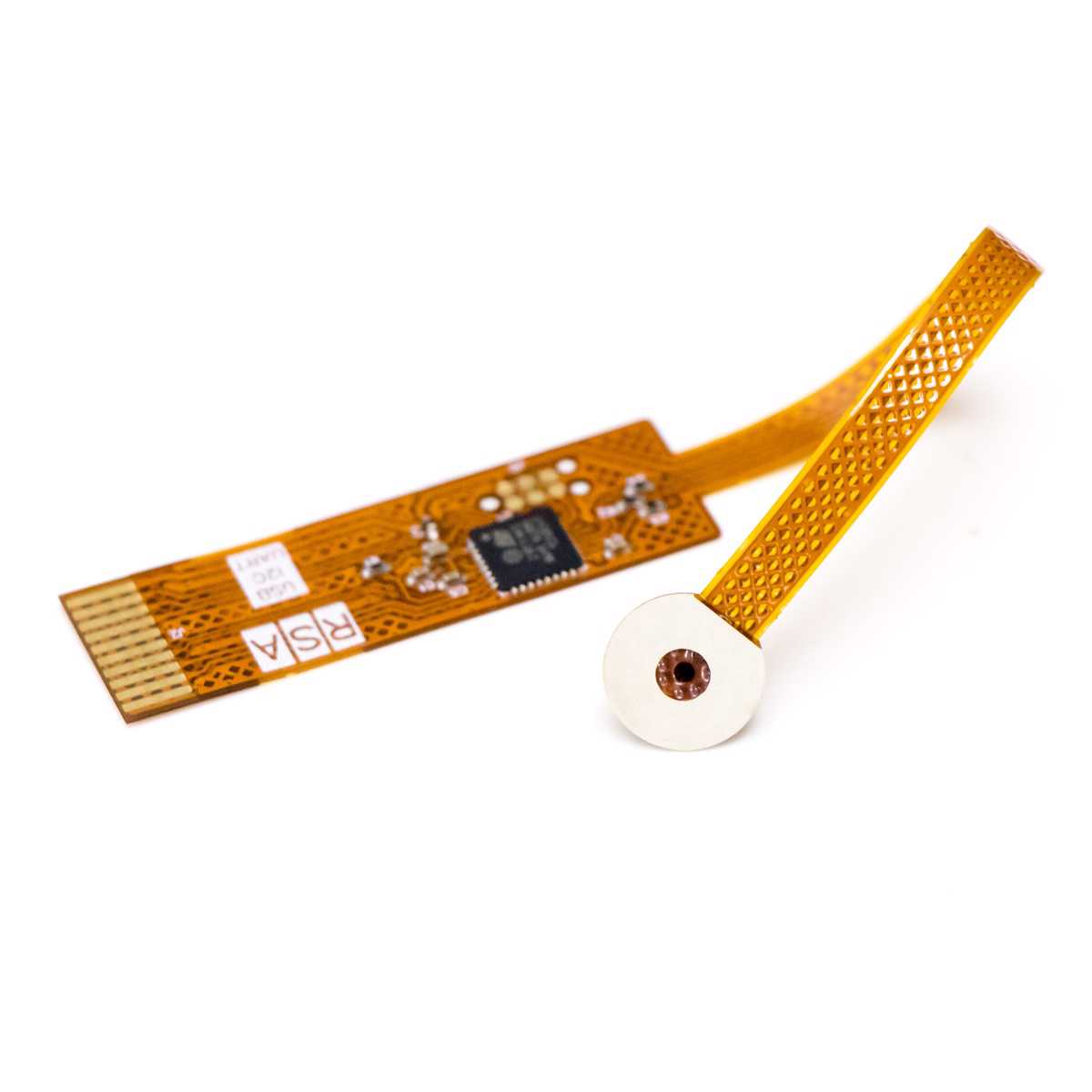
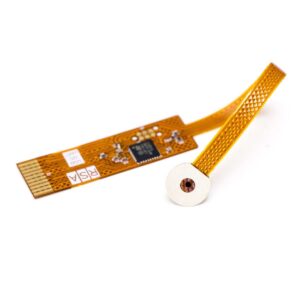
The microphone head is small enough to fit a ½-inch barrel, allowing use of industry-standard sound calibrators.
Every module is factory-checked for accuracy before it is shipped.
Raw audio is never stored and cannot be sent over any interface. Only sound level parameters can be read from the sensor.
The PCBA-DBM-FLEX modules are designed and characterised with reference to IEC 61672-1 Class 2 (and IEC 61260-1 Class 2 for the octave filters). They are not third-party certified or type-approved, and are best suited for for monitoring, screening and indicative measurement, not for legally binding noise studies.
Pinout and Hardware
Both variants use the same flexible PCB and 10-pin pinout. Only VDD,
GND, SDA and SCL need to be connected for using the module. INT is optional.
Pinout

| # | Name | Type | Description |
|---|---|---|---|
| Connect these | |||
| 10 | VDD | PWR | 1.70 – 3.6 V supply |
| 1, 6 | GND | PWR | Ground |
| 7 | SDA | I/O | Open-drain I²C data, 5 V tolerant |
| 8 | SCL | I/O | Open-drain I²C clock, 5 V tolerant |
| 9 | INT | OUT | Open-drain interrupt, active-low |
| Leave unconnected | |||
| 2, 3 | GPIO1/2 | RSVD | Reserved |
| 4, 5 | USB D−/D+ | RSVD | Reserved |
Mechanical and Mounting

Mounting
- Peel-off adhesive on the mic head, align mic and enclosure holes and press down firmly
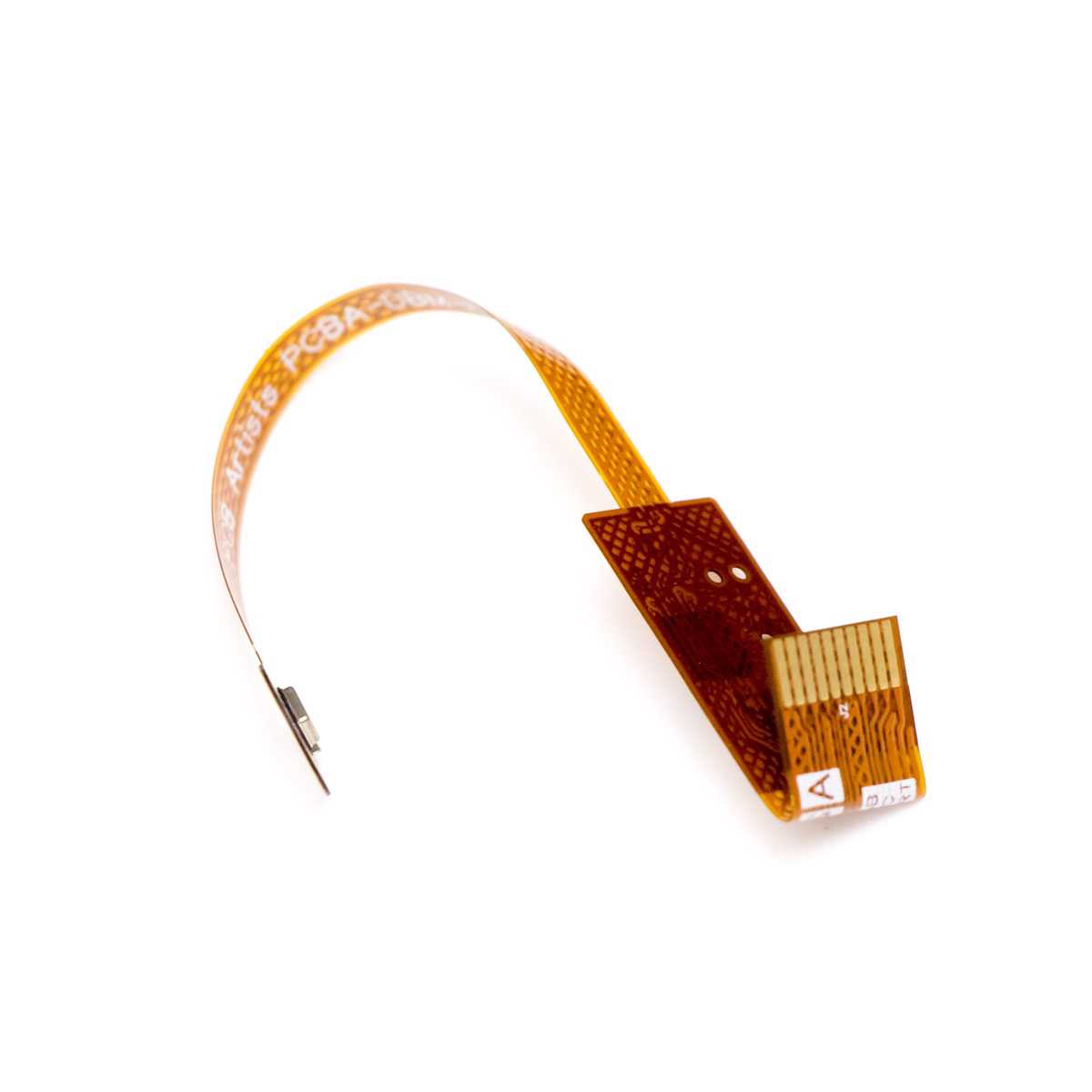
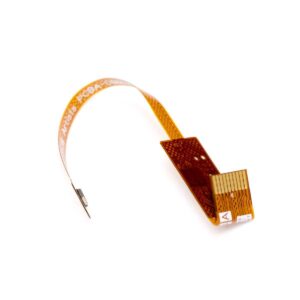
- Bends the flexible part to place the module body as convenient
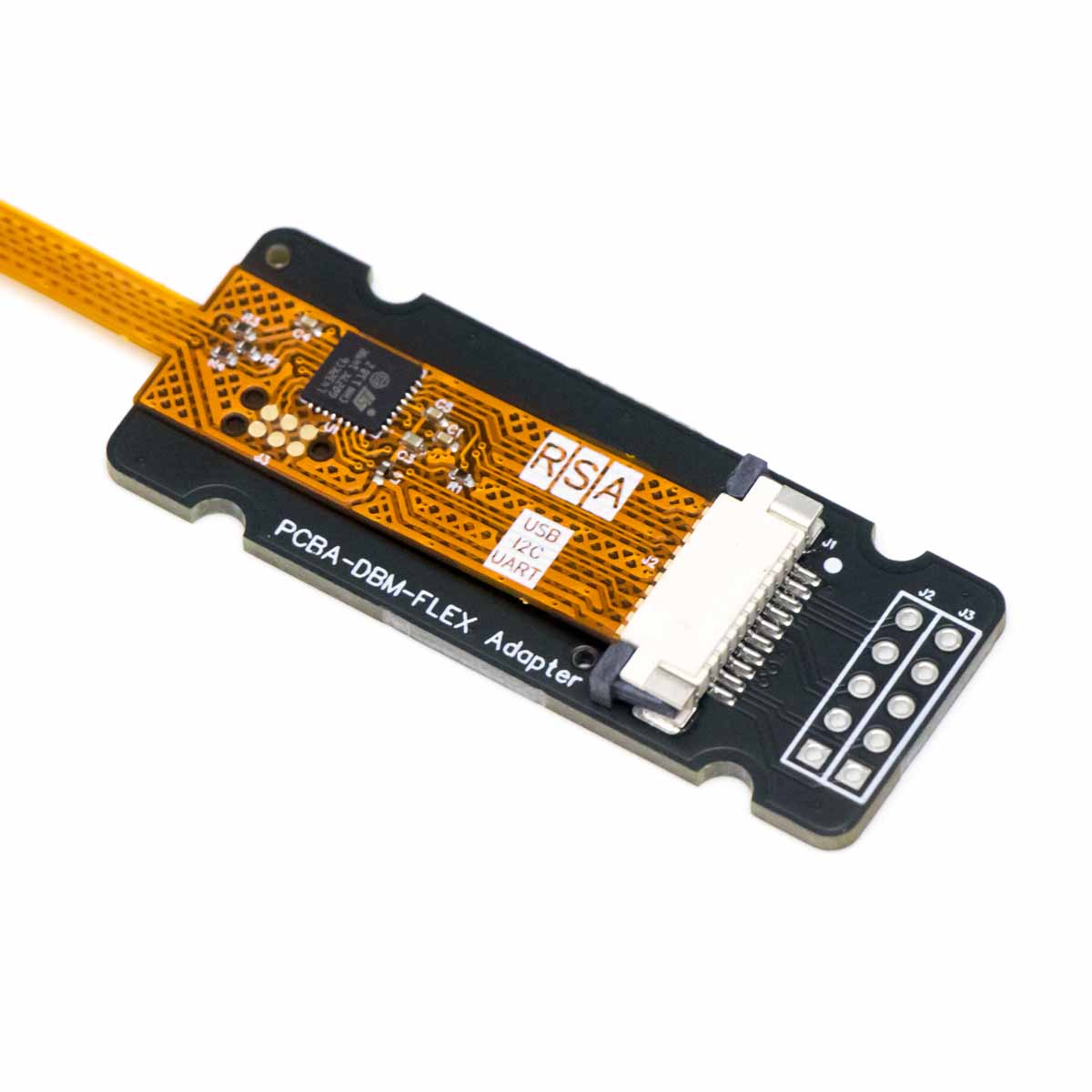
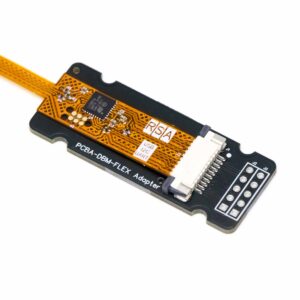
- Plug into a 10-pin, 1 mm top-contact FPC connector, or our adapter PCB
Protection
- Add the IP67 acoustic membrane for dust and water protection
- Secure the flexible part with polyamide tape to prevent movement/vibrations
- Keep VDD as clean as possible
Applications
An active current of only 1.9 mA and supply voltage of 1.8V allows for long-term operation on very limited power.Legacy
LAeq, peaks and seconds above 85 dB enable effortless implementation of noise exposure studies. Either
Low-frequency response and third-octave band analysis allow for detection of fan faults, bearing tone or abnormal noises. Octave
Privacy by design makes the sensor perfect for use in conference rooms, AirBnB, hotels, apartments and other private spaces.Either
Accessories
Connecting the PCBA-DBM-FLEX Sensor
Add an adhesive IP67 acoustic membrane to protect from dust and water.
Frequently Asked Questions (FAQs)
Can I turn off octave analysis in the PCBA-DBM-FLEX-Oct to save power?
No, the modules currently only support a fixed feature set. All measurements are always being evaluated.
We are developing lower power solutions and if that absolutely matters for your application, please contact us.
What is the best approach to writing host firmware for these flex sensors?
If your host firmware is developed to work with the PCBA-DBM-FLEX-Oct sensor, the same code can be re-used with minimal modifications to work with all our other sensors that feature 2-digit reading resolution (such as the Legacy and other Pro sensor series).
I want to use Claude or ChatGPT to develop my application firmware. How can I best do that?
To use Claude, ChatGPT, or any other AI tool, we have made the HTML datasheets of our sensors available via dedicated pages. Simply share the URL of the HTML datasheet with an AI platform of your choice and you will be able to generate working code within minutes. No need to parse heavy PDF documents!
I want to connect multiple sensors to the same I2C bus, how can I do that?
Even though the I2C address of the PCBA-DBM-FLEX modules is fixed during production, we can ship the modules with any pre-programmed 7-bit address ranging from 0x40 to 0x48.
Just leave a note on your order or mail us with your request.
How can I calibrate the PCBA-DBM-FLEX module in the field?
The PCBA-DBM-FLEX modules drift less than 3 dB through their operational life and frequent calibration is not needed. If you still need to check accuracy in the field, please ensure that you use a barrel design in your end product and insert the microphone of the PCBA-DBM-FLEX inside it to allow for calibration using standard equipment.
Reference half-inch barrel 3D design files (STP or STL) are available on request.
Need Something Different?
Customise this Sensor
We can customize flex length, connector, outline or firmware for volume orders (subject to MOQ).
Volume Pricing
We offer volume pricing and bulk purchase discounts (subject to MOQ and purchase history).
Reviews
There are no reviews yet.